














Automotive and Transportation
Digital solutions for dealerships, logistics, mobility, and transportation businesses.
We design and build REST and GraphQL APIs, AI-powered endpoints, and public developer platforms as products in their own right.
Contact Us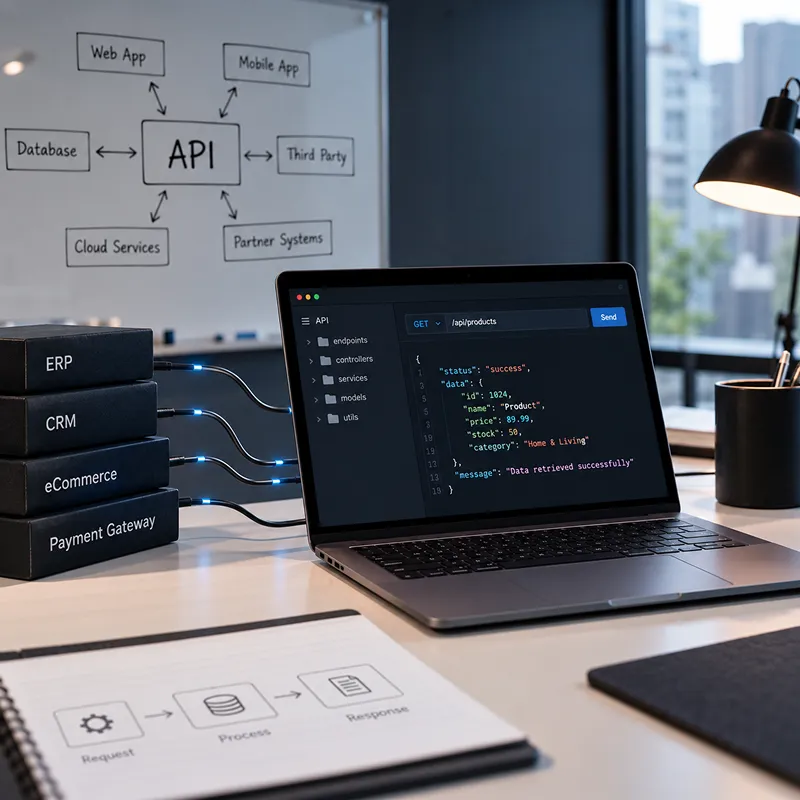
Below is an overview of the key areas we cover when designing and building custom API architecture, explained in more detail.
Explore custom API architecture we have delivered for businesses around the world, each one reflecting strong documentation and security practices.
Keyideas has built websites, platforms, and software products across more than 20 industry verticals over 18 years. We bring direct project experience to each industry we serve, not a generalist template applied to every client brief. Select an industry below to see what we have built in your market.

Healthcare websites, patient portals, appointment booking, and telemedicine solutions.

Websites for home improvement, maintenance, renovation, and repair services.

Custom software and websites for manufacturing and industrial businesses.
API development only works when grounded in real expertise across design, security, and developer experience tools.
Technologies We Use
Built for Modern Platforms
We build secure, scalable APIs with REST, GraphQL, third-party integrations, authentication, webhooks, and performance optimization that connect systems, automate workflows, and support business growth.
Businesses increasingly design APIs as a core part of application architecture from day one, making it easier to connect additional consumers, mobile apps, partner systems, later without retrofitting connectivity into an application that was never designed to expose its own data. We design REST and GraphQL API architecture, produce documentation before implementation begins, and build for the scale the API will actually need once more than the first consumer connects, rather than treating the API as an afterthought bolted onto a finished application.
AI is becoming a core part of modern applications, and the API layer determines whether AI capability is built as a proper, reusable service or bolted on as a one-off script nobody else can call. We build API layers around OpenAI, Azure OpenAI, and Anthropic that expose AI-powered search, recommendations, and automation as clean, documented endpoints, so AI functionality becomes a genuine part of the application’s architecture rather than a fragile script wired into one specific feature.
Building an API that only supports scheduled polling leaves every consumer working with data that is stale between refresh cycles, exactly the gap real-time event-driven architecture is designed to close. We build webhook and event-driven API infrastructure that pushes updates the moment an event occurs, order placed, inventory changed, shipment updated, with the retry logic and idempotency handling reliable event delivery genuinely requires rather than a basic webhook that silently drops events during a network failure.
Organizations with legacy applications are modernizing older APIs as part of broader application modernization and cloud migration initiatives, particularly in enterprise software, manufacturing, financial services, and healthcare. We restructure legacy APIs, migrate them to modern frameworks, and build the bridge layer that lets a legacy system continue operating while new applications connect to it through a properly documented, versioned API rather than the undocumented direct database access legacy systems often relied on.
As businesses expose more data and functionality through APIs, security has become a fundamental part of API development rather than an afterthought, particularly for financial services, healthcare, ecommerce, and B2B applications handling sensitive data. We implement secure API architecture with OAuth 2.0 authentication, granular authorization, API gateways for centralized access control, and security testing that verifies the API holds up under adversarial conditions, not just normal usage.
As the number of APIs a business operates grows, real visibility into performance, usage, errors, and availability becomes essential, particularly for enterprise applications, SaaS, and platforms running many concurrent consumers. We implement API monitoring and logging that tracks error rates and latency per endpoint, usage analytics that show which endpoints matter most, and the versioning and documentation practices that keep an API manageable as its consumer base grows beyond what a single team can track informally.
APIs remain fundamental to microservices and modular architectures, letting different application components communicate while being developed and scaled independently, which matters most for SaaS, enterprise software, and other high-scale applications. We design the service-to-service API contracts that let individual components be deployed, scaled, and maintained independently, building the modular architecture that supports a growing engineering team without every change requiring coordination across the entire application.
Headless commerce depends on a well-built API layer connecting storefronts to product catalogs, inventory, payments, and search, and a poorly designed API layer becomes the bottleneck that limits how fast a headless frontend can actually move. We build custom API layers and backend-for-frontend services for headless commerce architecture, exposing product, inventory, payment, and search data as endpoints a custom storefront controls directly rather than depending entirely on a platform’s default API surface.
Treating REST or GraphQL as a single company-wide default ignores that the right choice actually depends on what a specific API needs to do, not a blanket architectural preference applied everywhere. We use REST for simple, resource-oriented, publicly cacheable endpoints where broad tooling support and a lower learning curve matter, and GraphQL for applications with complex, deeply nested data relationships where reducing over-fetching meaningfully improves performance, often building both within the same system for different purposes.
An API with no documentation, or documentation that drifted out of sync with the actual implementation months ago, forces every new consumer to ask a developer questions the documentation should have already answered. We build OpenAPI and GraphQL schema documentation, SDKs, and interactive documentation portals that stay in sync with the actual implementation through automated contract testing, reducing the support burden of onboarding new API consumers rather than treating documentation as a compliance checkbox nobody maintains.
An API built without rate limiting or a scalability plan works fine at low traffic and then fails precisely when the business succeeds and traffic actually grows, which is the worst possible time for an API to become the bottleneck. We build rate limiting, throttling, and quota management per consumer, along with caching and load distribution strategies for high-traffic endpoints, architecting APIs for the traffic level the business will eventually reach rather than only the traffic it has today.
A SaaS company deciding to open its platform to external developers is building a genuinely different kind of API than an internal service, one that strangers with no context need to discover, understand, and trust enough to build a business on top of. We build public and partner API platforms with developer onboarding flows, API key management, sandbox environments, and versioned endpoints, treating the API itself as a product other developers evaluate rather than an internal implementation detail.
Writing API code before actually deciding on endpoint design, authentication model, and versioning strategy means building on assumptions that often need to be undone once real consumer requirements become clear. We start every API engagement with architecture documentation covering endpoint design, authentication model, versioning strategy, and data contract, because these decisions determine whether the API remains maintainable as more consumers connect over time rather than becoming harder to change with every new integration.
An API left unmaintained as more consumers connect to it accumulates outdated dependencies, drifting documentation, and security gaps that make the next breaking change far riskier than it needed to be. We provide ongoing API support and maintenance, including a dedicated API developer through our Enterprise Partnership model, keeping dependencies, documentation, and security current as the API’s consumer base grows rather than letting the API quietly decay until a breaking change actually happens.
We use industry-leading tools to ensure smooth communication, efficient development and transparent project management
Plan tasks, timelines, and project resources efficiently.

Build scalable solutions with clean and secure code.

Monitor performance, fix issues, and manage updates.

Create wireframes, UI designs, and interactive prototypes.

Conduct meetings and discussions to stay aligned.
Questions from technical decision-makers and CTOs about API development with Keyideas today, covering architecture, security, timelines, and full project scope.
Have a question or need support? Our team is here to help and will get back to you within one business day.
* indicates required fields