






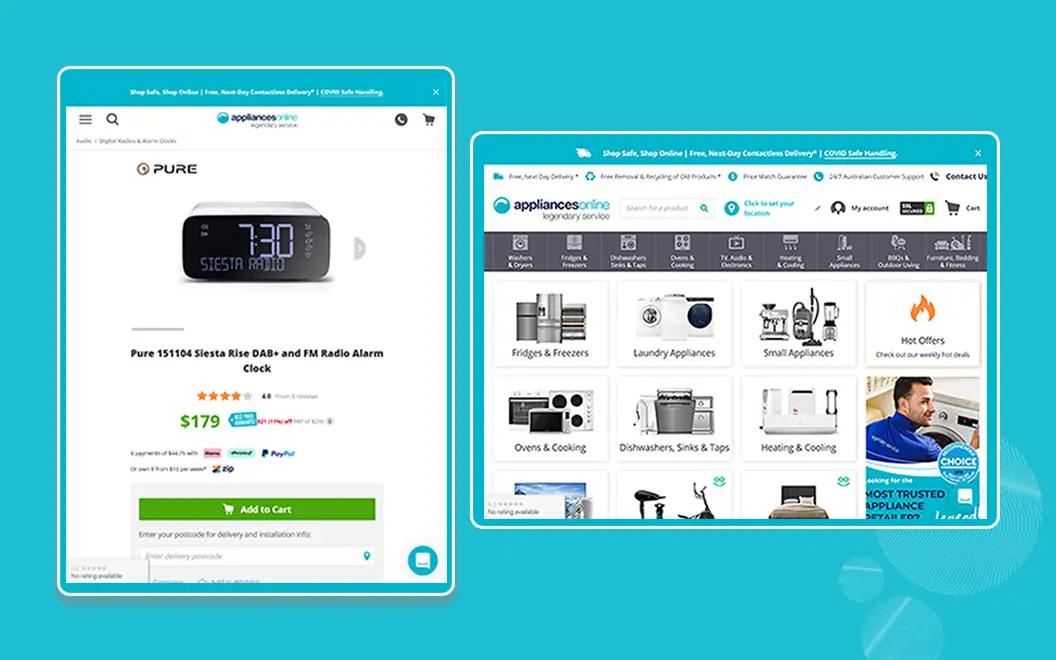


Automotive and Transportation
Digital solutions for dealerships, logistics, mobility, and transportation businesses.
We build ASP.NET Core applications, .NET Web APIs, and Azure-integrated back-end systems for enterprises in the Microsoft ecosystem.
Contact Us
Below is an overview of the key areas we cover when building enterprise .NET applications and APIs, explained in more detail below.
Explore real .NET applications we have delivered for industrial, energy, and B2B commerce clients around the world, each reflecting genuine enterprise-grade architecture.
Keyideas has built websites, platforms, and software products across more than 20 industry verticals over 18 years. We bring direct project experience to each industry we serve, not a generalist template applied to every client brief. Select an industry below to see what we have built in your market.

Healthcare websites, patient portals, appointment booking, and telemedicine solutions.

Websites for home improvement, maintenance, renovation, and repair services.

Custom software and websites for manufacturing and industrial businesses.
.NET development only works when grounded in real expertise across Azure, AI, and testing tools.
We Build On
We Migrate From
From ASP.NET Core applications and Web APIs to Entity Framework, Azure, testing, SignalR, and microservices, we build .NET solutions around the technical and business requirements of each product.
We implement Clean Architecture separating domain, application, persistence, and API layers with defined dependency rules that keep business logic independent of the delivery mechanism. Minimal APIs suit microservices and low-ceremony endpoints; controller-based APIs suit larger systems where action filter pipelines enforce consistency across hundreds of endpoints. Middleware pipeline ordering is treated as architecture rather than configuration, because incorrect sequencing of authentication, authorization, and exception handling produces security vulnerabilities that only manifest under specific request patterns in production.
We design .NET Web APIs with resource-oriented URL structures, correct HTTP semantics, standard status codes, and RFC 7807 problem detail error responses that consuming teams handle consistently. API versioning using URL segment or header strategies with a defined deprecation timeline is implemented before the first external consumer connects. The OpenAPI specification produced by Swashbuckle is reviewed before implementation begins, so consuming teams identify interface design problems at the contract stage rather than discovering them during integration testing.
We configure Entity Framework DbContext with Fluent API configurations in dedicated classes, separating schema definition from the domain model so both can evolve independently. AsNoTracking on read-only queries eliminates change tracking overhead; explicit Include statements replace lazy loading so every query’s SQL is predictable and reviewable before reaching production, preventing the N+1 patterns that lazy loading produces invisibly. All schema changes go through EF Core migrations applied via CI/CD pipeline and code-reviewed like application code, never applied manually between environments.
We integrate Azure Active Directory for enterprise single sign-on, multi-tenant authentication, and managed identity service-to-service authentication that eliminates credential rotation. Azure Key Vault replaces connection strings, API keys, and AI service credentials in application configuration from the first deployment. Azure Service Bus handles asynchronous messaging between .NET services, and Azure Functions provide serverless event-driven processing that extends .NET applications without adding to the web API surface that consumes dedicated compute resources.
We implement ASP.NET Core Identity for registration, email confirmation, two-factor authentication, and OAuth integration with an extensible custom user store. Policy-based authorization keeps authorization rules in testable requirement and handler classes rather than ad hoc role checks scattered across controllers that grow inconsistent as the application evolves. JWT bearer authentication for SPA and mobile API consumers covers Key Vault signing key management, validation parameters, and the access and refresh token lifecycle suited to each consumer type’s session behavior and security requirements.
We implement ASP.NET Core SignalR for live notifications, collaborative editing features, and real-time dashboard updates, with transport negotiation between WebSockets, Server-Sent Events, and long polling handled automatically. The Azure SignalR Service backplane routes messages between clients connected to different server instances without sticky sessions on the load balancer. Hub authentication integrates with ASP.NET Core middleware, passing the JWT through the WebSocket query string because WebSocket connections cannot carry Authorization headers during the upgrade handshake.
We design .NET microservice boundaries around bounded contexts with each service owning its data store and exposing data only through a defined API. .NET Aspire provides cloud-native orchestration for distributed .NET applications, simplifying the service discovery, configuration, and observability setup that microservice deployment on Azure requires. Polly resilience policies implement retry with exponential backoff for transient failures and circuit breakers for consistently failing downstream services; ASP.NET Core health check endpoints serve Kubernetes readiness probes, Azure App Service health integration, and load balancer configuration.
We write xUnit unit tests for .NET service layer logic with Moq mocks for repository and external adapter dependencies, verifying business rules independently of infrastructure. WebApplicationFactory integration tests create a test server running the full application pipeline, making real HTTP requests that verify middleware, authentication, and Entity Framework against a test database, catching integration failures that unit tests with mocked dependencies cannot surface. FluentAssertions produce failure messages that communicate what was expected and what was received, reducing investigation time for failing CI builds significantly.
We integrate AI and machine learning capabilities into .NET applications using ML.NET for on-premises model inference within C# code without a Python service layer, Azure OpenAI Service through the Azure.AI.OpenAI SDK for generative AI features including chat completion, embedding generation, and function calling, and Semantic Kernel for orchestrating LLM-powered workflows within ASP.NET Core applications. Microsoft.Extensions.AI provides the abstraction layer that allows switching between AI providers without rewriting application code. AI service calls are wrapped in Polly resilience policies covering retry, circuit breakers, and timeouts appropriate to LLM endpoint latency characteristics.
Financial services and FinTech businesses choose .NET for C# type safety, Azure Active Directory enterprise authentication, and the audit trail architecture that regulatory compliance requires. We build trading platform back ends, investment management APIs, payment processing services integrating with open banking providers, and the regulatory reporting systems that financial institutions need from a technology stack with Microsoft’s enterprise support commitment behind it. EF Core migrations provide the schema change audit trail that financial services change management requires, and Azure Key Vault stores the cryptographic material that payment processing security demands.
Healthcare organizations and enterprise businesses choose .NET for compliance-aware architecture, Azure AD integration with existing Microsoft 365 infrastructure, and HIPAA-aware deployment options that Azure’s regulated workloads capability provides. We build clinical workflow APIs, EHR integration back ends, patient portal applications, and the enterprise operations platforms that large organizations need when the Microsoft ecosystem is already the established standard. .NET’s long-term LTS support commitments align with the enterprise IT lifecycle planning that healthcare procurement, government IT governance, and regulated industry change management processes require.
Taking over an existing .NET codebase without first auditing its actual condition means discovering business logic buried in controllers, lazy loading producing N+1 queries on every page load, or missing migrations only after a remediation timeline has already been committed. We start every codebase takeover with an audit covering architecture quality, Entity Framework query patterns, test coverage, .NET version currency, Azure configuration quality, and security posture, producing an honest assessment and a prioritized remediation plan before we commit to a timeline rather than after.
An application still running on the original .NET Framework is on a platform in maintenance mode with no new feature development, accumulating risk every month closer to Microsoft’s published end-of-support date for that version. We assess .NET Framework applications for migration to .NET 8 LTS, the cross-platform, open-source, actively invested version with a three-year support commitment, planning an incremental migration path that preserves business logic rather than treating the move as a ground-up rewrite that risks losing years of accumulated application behavior.
A .NET application left unmaintained after launch accumulates outdated NuGet packages, drifting Azure configuration, and security gaps that make the next feature request more expensive than it needed to be. We provide ongoing .NET support and maintenance, including a dedicated developer through our Enterprise Partnership model, keeping dependencies, Azure configuration, and security current while Application Insights continues monitoring production, rather than letting the application quietly decay until a dependency vulnerability or Azure service change forces an unplanned emergency fix.
We use industry-leading tools to ensure smooth communication, efficient development and transparent project management
Plan tasks, timelines, and project resources efficiently.
Build scalable solutions with clean and secure code.
Monitor performance, fix issues, and manage updates.
Create wireframes, UI designs, and interactive prototypes.
Conduct meetings and discussions to stay aligned.

Questions from engineering teams and technical decision-makers about .NET development with Keyideas today, covering scope, timelines, and full project cost.
Have a question or need support? Our team is here to help and will get back to you within one business day.
* indicates required fields