
Ecommerce websites are no longer built to exist online. They are engineered to convert attention into revenue at speed. Brands winning today are not adding features randomly. They are applying proven patterns already working at scale across global ecommerce leaders.
Below are the most important ecommerce website trends, each with one eye catching takeaway and a live industry example, along with the technology stacks powering them.
AI Powered Personalization
The best ecommerce websites do not wait for customers to search. They predict what customers want.
Live Industry Example: Amazon
Amazon dynamically changes homepage layouts, product recommendations, and pricing logic based on browsing history and behaviour. This real time personalization is a major driver of its conversion dominance.
Technology Stack Relevance (Shopify, WooCommerce, Node.js, MongoDB, React, Next.js)
Modern Shopify and WooCommerce stores now replicate this approach using Node.js for real time data processing, MongoDB for behavioural data storage, and React or Next.js for dynamic UI updates.
Headless Ecommerce Architecture
When growth breaks your website, headless fixes it
Live Industry Example: Nike
Nike adopted headless commerce to unify its website, mobile app, and in store digital experiences while maintaining lightning fast performance.
Technology Stack Relevance (Shopify, WooCommerce, React, Next.js, .NET, Node.js)
Headless setups commonly use Shopify or WooCommerce as the backend, with React or Next.js on the frontend and Node.js or .NET APIs handling integrations and scalability.
Performance First Ecommerce Design
Every second your site is slow, customers leave silently
Live Industry Example: Walmart
Walmart publicly reported that even small performance improvements led to measurable increases in conversions and revenue.
Technology Stack Relevance (Next.js, .NET, Node.js, MongoDB)
Performance focused ecommerce builds rely on Next.js server side rendering, optimised APIs using .NET or Node.js, and efficient databases such as MongoDB to minimise response times.
Mobile First Ecommerce Experience
If it does not work on a thumb, it does not work at all
Live Industry Example: ASOS
ASOS redesigned its mobile experience to prioritise navigation, fast checkout, and simplified UX, resulting in stronger mobile engagement and conversions.
Technology Stack Relevance (Shopify, WooCommerce, React, PWA Enhancements)
Modern mobile ecommerce experiences often use React based UI components, lightweight Shopify or WooCommerce themes, and PWA style performance enhancements.
Conversational Commerce
The fastest way to sell is to answer before customers ask
Live Industry Example: Sephora
Sephora uses AI chat and conversational tools to guide users through product discovery and purchase decisions, especially for complex products.
Technology Stack Relevance (Node.js APIs, AI Assistants, Frontend Integration)
Conversational systems are typically powered by Node.js backends, integrated into ecommerce platforms via APIs and surfaced through modern frontend frameworks.
Advanced On Site Search and Product Discovery
Search is the highest converting salesperson on your website
Live Industry Example: eBay
eBay continuously invests in intelligent search to help users quickly find relevant listings despite massive inventory scale.
Technology Stack Relevance (React, Next.js, MongoDB, Intelligent Search)
Advanced search combines React or Next.js frontends, intent based logic, and fast data indexing using MongoDB or search services, significantly improving discoverability.
Video First Product Experiences
If customers cannot experience it, they will not trust it
Live Industry Example: Apple
Apple uses high quality product videos and interactive visuals to replicate in store experiences online and reduce buyer hesitation.
Technology Stack Relevance (Optimised Media Delivery, Modern Frontend Frameworks)
Video commerce requires performance optimised delivery, lazy loading, and modern frontend frameworks to avoid slowing down ecommerce websites.
Trust First UX and Secure Ecommerce
Trust is the real checkout button
Live Industry Example: Shopify
Shopify emphasises transparent checkout, visible security indicators, and frictionless payment flows to increase merchant conversions.
Technology Stack Relevance (.NET, Node.js, Secure Checkout Architecture)
Secure ecommerce builds leverage .NET or Node.js for backend robustness, combined with clean and predictable frontend experiences.
Omnichannel and Unified Commerce Experiences
Customers do not see channels. They see experiences.
Live Industry Example: Zara
Zara seamlessly connects online browsing, in store inventory, and fulfilment, creating a unified shopping journey.
Technology Stack Relevance (Shopify, WooCommerce, APIs, MongoDB, Node.js, .NET)
Unified commerce architectures often integrate Shopify or WooCommerce with Node.js or .NET APIs and centralised databases such as MongoDB.
How Keyideas Helps Brands Apply Ecommerce Trends Strategically
Execution Focused Ecommerce Engineering
This is where Keyideas differentiates itself. Instead of blindly adopting trends, Keyideas evaluates what has already proven successful in live ecommerce environments and applies those patterns strategically.
By working across Shopify, WooCommerce, React, Next.js, .NET, Node.js, and MongoDB, Keyideas builds ecommerce solutions that are fast, scalable, and conversion driven without unnecessary complexity.
Final Takeaway
Trends do not win markets. Execution does.
Ecommerce leaders succeed not by chasing trends, but by implementing the right ones with the right technology and the right strategy.
When trends are grounded in real industry success stories, they become growth multipliers rather than experiments.
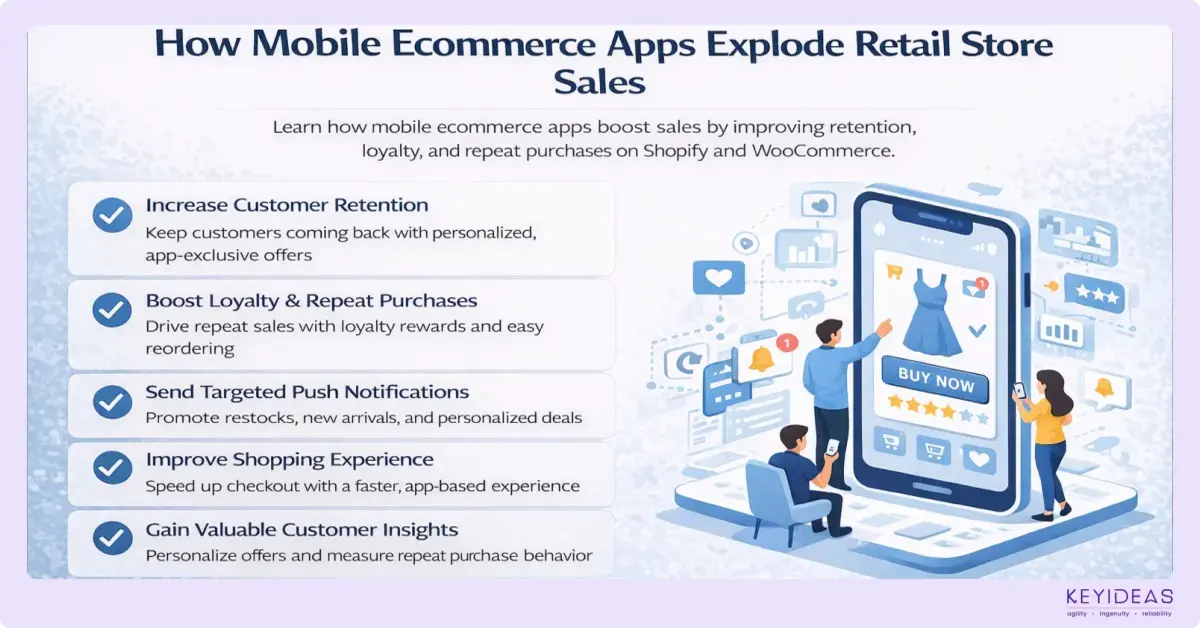
With mobile shopping on the rise, recent mobile ecommerce statistics reveal a major shift in consumer behavior. Over 70% of retail traffic now comes from smartphones, showing how vital mobile-optimized stores have become. These mobile ecommerce statistics also highlight higher conversion rates from apps compared to desktop, proving the value of seamless UX and responsive design. Brands leveraging mobile strategies see increased engagement and revenue. As mobile ecommerce statistics continue to trend upward, investing in mobile-friendly platforms is essential for sustained growth in the digital marketplace.

Building an SEO friendly ecommerce website is crucial for visibility and performance in search engines. A responsive design ensures seamless browsing across devices, which directly supports responsive SEO practices. From clean code and mobile optimization to keyword-rich product descriptions and fast-loading pages, every element contributes to better rankings. Creating a responsive SEO foundation allows your SEO friendly ecommerce website to reach more customers, improve user experience, and boost conversions. Invest in strategies that make your ecommerce store both visually appealing and search engine optimized.

Understanding the impact of blogging vs ecommerce is key to unlocking digital growth and building a strong brand presence. While ecommerce websites focus on transactions, blogging builds organic traffic, boosts SEO, and increases customer engagement. Combining blogging vs ecommerce strategies creates a content-driven ecosystem that not only promotes products but also builds authority and trust. Brands embracing both blogging and ecommerce benefit from higher search rankings, improved credibility, and long-term conversions. The blogging vs ecommerce balance is essential for sustained success in today's competitive digital landscape.

Choosing the right software outsourcing partner is crucial for project success and long-term collaboration. This blog outlines key factors to consider, from technical expertise and cultural compatibility to communication practices and pricing models. By understanding what sets top software outsourcing services apart, businesses can avoid common pitfalls and build productive partnerships. Learn how to evaluate vendors, define your expectations, and align on project goals to ensure your software outsourcing partner delivers quality, efficiency, and scalability every step of the way. Discover how outsourcing can streamline workflows while boosting your competitive edge.